Employee Recognition Programs: How to Build One, Plus 30 Ideas That Work

- Most employee recognition programs mix four types of recognition: peer-to-peer, manager-led, milestone and service, and non-monetary.
- Build in order: set goals, define criteria and budget, choose your recognition mix, pick your tooling, launch and communicate, then measure and iterate. The launch is the step most companies rush.
- Choice drives usage. When employees can turn recognition into a reward they actually want, they keep showing up for it.
- At high-performing companies, which WTW says focus on the wellbeing, growth, and recognition of their people, employees are twice as likely to stay with their employer and be fully engaged.
There's a big difference between recognition that gets announced and recognition that gets used.
So why do so many recognition programs start out really strong and then kind of disappear? Almost always, the program got announced once, in an all-hands slide or a kickoff email, and nothing was built to keep it going. Below is what a recognition program actually is, how to build one step by step, and 30 ideas you can put to work this week.
What Is an Employee Recognition Program?
An employee recognition program is a structured, ongoing way for a company to acknowledge employees for their work, their milestones, and the way they live the company's values. It usually combines peer-to-peer and manager recognition, automated moments like work anniversaries, and rewards employees can choose, so appreciation happens every week, not just at the annual awards dinner.
That last part matters most. It can't be half-hearted. It can't be something buried in a total rewards document that we hope people are gonna read.
Here's why I care so much about it. The reason you have recognition at all is so that people can praise one another and thank one another and show appreciation to one another. That builds culture. Culture builds buy-in. Buy-in builds loyalty. You get better retention and better morale, and you get a place where people actually want to be.
The research points the same way. WTW found that at high-performing companies, the ones that focus on the wellbeing, growth, and recognition of their people, employees are twice as likely to stay with their employer and be fully engaged. You shouldn't need a stat to know that people who feel valued stay. But if you need to make that argument to somebody, the stats are there.
The Main Types of Employee Recognition
Most programs are built from four types of recognition. You don't need all four on day one, but the best employee recognition programs end up using every one of them.
Peer-to-peer recognition. Coworkers thanking coworkers. This is where volume comes from, because peers see the work managers miss. It's also where recognition starts to feel like culture instead of a performance review. I wrote a whole guide on peer-to-peer recognition if you want to go deeper.
Manager-led recognition. The words that come from someone's boss land differently. Managers also carry a big responsibility here, because recognition can actually turn negative when only some managers do it. If one team hears "thank you" every week and the team down the hall never does, people notice. They compare notes.
Milestone and service recognition. Birthdays, work anniversaries, promotions, a big certification someone finally passed. These are the moments that should never depend on somebody's memory. Here's the pattern I see: new hires get tons of feedback, because they need it. Then, as people settle into their roles and just start producing, the acknowledgment slips. Your five-year employee is often the least recognized person on the team. Milestones are your safety net against that.
Non-monetary recognition. A public shoutout, a handwritten note, a leader calling something out in a meeting. It costs nothing and it matters a lot.
People mix up recognition and rewards all the time. They're related, but they're not the same thing: recognition is the acknowledgment, and the reward is the tangible follow-through. If you want the full breakdown, here's how I think about rewards and recognition working together.
How to Build an Employee Recognition Program, Step by Step
If you're trying to figure out how to create an employee recognition program from scratch, do it in this order. The order matters more than people think.
1. Set your goals
Start with why. Is it retention? Is it making your values more than words on a wall? Is it fixing a specific engagement survey result? Too often we look at people programs and get obsessed with what the market is doing and what our competitors are doing. That's keeping up with the Joneses. And guess what? What others are doing isn't working. Pick goals that are about your people, not about a benchmark.
2. Define your criteria and budget
Decide what you're recognizing. I'd strongly suggest tying it to your company values. Here's why: everybody walks into a company with their own idea of what matters most. Maybe their childhood taught them hard work and loyalty are all that counts. Not every human being agrees on that. Company values exist to say, these are the things we've agreed we're all determined to value here.
At Fringe, one of ours is "we act with courage." You may have grown up being told "be careful" five thousand times and "be courageous" maybe once. That's fine. But at Fringe, courage is what's expected. And when you praise people for exhibiting the values, you get to see who's exhibiting them. Praise the behavior you want to see and you're going to get more of it.
Then set a real budget. What you shouldn't do is launch a program you severely underfund. If you hand someone five bucks and say "go have a nice lunch," you haven't really given anything. You might as well have given them a coupon. It matters how much you give, how often you give it, and what you give.
3. Choose your recognition mix
Pick which of the four types you'll start with, and how they work together. A good starting mix is everyday peer recognition, a simple manager habit, and automated milestones. You can layer in awards and nominations later once the habit is there.
4. Pick your tooling
This is where a lot of programs go wrong, because they think the tool is the program. It isn't. A tool is a tool. I could have the best hammer in the whole world, and if I don't know how to swing it at a nail, I'm not nailing anything down.
That said, the right tool removes friction. Look for recognition that lives where people already work (Slack or Teams), points that can be attached to a recognition, automated birthdays and anniversaries, budget controls, and rewards employees actually want. An employee rewards and recognition platform that does all of that in one place keeps you from stitching together three or four vendors that each charge their own fee.
5. Launch and communicate
This is the step almost everyone skips. They build the plan, they buy the software, they send one email, and they consider it done. It's not finished once it's conceptualized.
An invitation to everyone is an invitation to no one. You have to get down to the individual level, where managers are inviting people in, sending the first recognitions themselves, and telling their own stories. Get some champions involved. Communicate it over and over again, in several different ways, by the right people, with enthusiasm. And leaders have to go first, then keep going. People take their cues from what leadership actually does, not what the launch email said.
6. Measure and iterate
Look at whether people are actually using it, and then ask them what it felt like. Don't just run the program. Learn your people. More on this below.
30 Employee Recognition Ideas That Work
Here are 30 employee recognition ideas, grouped the way most programs actually run. Every one of these is helpful to someone. None of them will be helpful to everyone, which is why you mix them. None of these will work if they live in a document nobody reads, so treat this list as employee recognition program ideas to put into motion, not ideas to admire.
Everyday Peer Recognition (1 to 8)
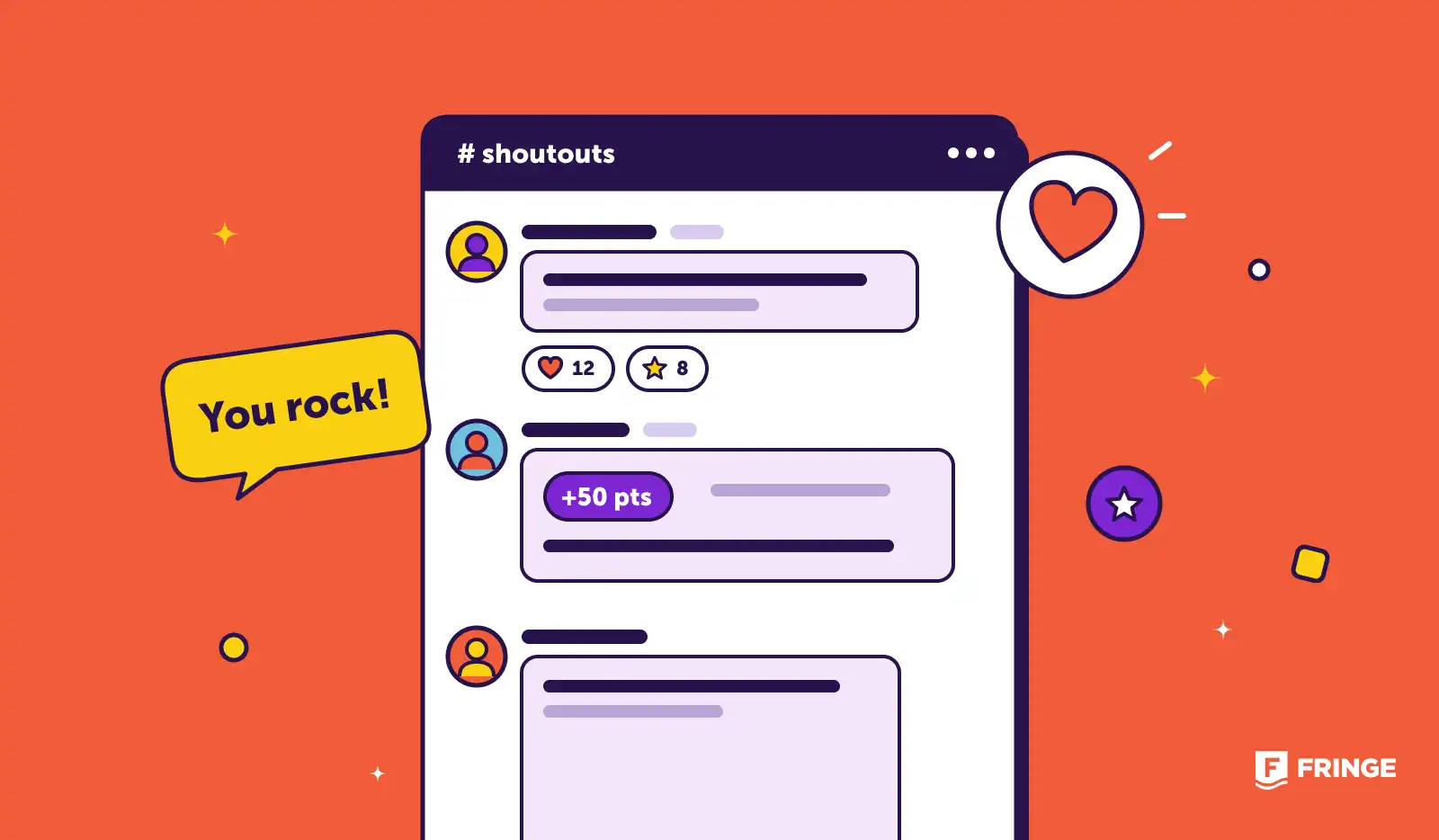
1. Values shoutouts. A quick public note that names the specific value someone showed. Naming the value tells everyone else what it looks like in practice.
2. A recognition channel in Slack or Teams. Put it where people already talk so it doesn't feel like one more login.
3. Points attached to peer recognition. A small number of points with each shoutout turns a nice moment into something the person can actually use.
4. Shout-Out Week. Run a company-wide challenge where the goal is simply recognizing each other. Challenges and incentives make it easy to set up and track.
5. Cross-team thank-yous. Prompt people to recognize someone outside their own team. It's how recognition stops being a popularity contest inside one department.
6. A running scoreboard. Send a weekly company-wide note with the total recognitions sent, days left in the quarter, and progress toward a goal. Nissin did exactly this (more below). Visibility keeps it alive.
7. New hire welcome shoutouts. Have teammates publicly welcome a new person in their first week and name one thing they're already bringing.
8. Peer-nominated monthly award. Let employees nominate the person who most visibly lived a value that month.
Manager-Led Recognition (9 to 15)
9. The five-second thank-you. It takes five seconds to tell someone they're doing a great job. Make it a weekly habit, not a quarterly event.
10. Recognition in the moment. Recognition should feel real, and it should feel real right in the moment it's earned. Not two months later in a review.
11. Praise before critique. If the only time someone hears from their manager is when something went wrong, every piece of feedback sounds like a giant problem. Consistent praise makes the hard conversations land.
12. Specific, written notes. Say exactly what the person did and why it mattered. Specific always beats generic.
13. Manager recognition budgets. Give each manager points to give, with budgets set by team so it stays fair.
14. Leadership spotlights. An executive calls out one person by name in an all-hands, with the story behind it.
15. Skip-level recognition. A note from your manager's manager lands differently. Encourage senior leaders to do this regularly.
Milestones and Anniversaries (16 to 22)
16. Automated work anniversaries. Never let a work anniversary slip by. Automate it, then add a personal note on top.
17. Birthdays, with choice. Give points for birthdays so people can pick something they want, instead of a cake they didn't ask for.
18. Service milestones that scale. Year one, year three, year five, year ten. Make each one bigger and more meaningful than the last.
19. Promotion celebrations. Publicly celebrate promotions and name the work that got them there.
20. Life events. A new baby, a wedding, a new puppy, a new house. Showing up at the right moment is elite employee experience.
21. Project wrap-ups. Recognize the whole team when a big project ships, and call out the people behind the scenes.
22. Certifications and learning wins. When someone finally passes the exam they've been grinding toward, make some noise about it.
Non-Monetary and Low-Cost (23 to 30)
23. Handwritten notes. Old school, and people keep them. A card in someone's desk drawer outlasts a Slack message by years.
24. A "wins" segment in team meetings. Five minutes at the start of the week for people to recognize each other out loud.
25. A "never recognized" check. Once a quarter, pull the list of employees who haven't received a single recognition. Then hand it to their managers. It's the most useful report nobody runs.
26. Department one-pagers. Give each manager a one-page cheat sheet with what to recognize and how. Small, everyday recognition is easier when people have examples.
27. Time off as a thank-you. An afternoon off after a brutal launch week is a reward people actually feel.
28. Recognize the long-timers on purpose. Acknowledgment slips with tenure. Set a reminder to recognize your most tenured people for something other than their anniversary.
29. Customer kudos, shared. When a customer praises someone, forward it to the team and the person's manager.
30. Ask people how they want to be recognized. Some people love a public shoutout. Some would rather get a private note. Find out.
Employee Recognition Examples
Here are a few employee recognition examples that show what this looks like when a company actually commits.
Nissin International Transport USA. Nissin's engagement survey said people wanted more recognition, especially for living the company's core values and going the extra mile. Their CEO set a goal of 26,000 recognition points in a single quarter and gave HR full latitude to make it happen. HR sent a weekly company-wide email with the running total, the days left, and the percentage to goal. Leadership went first. The result: 28,412 points (109% of goal) across 1,230 individual recognitions, reaching 92% of eligible employees. That's 1,230 times somebody said "thank you" or "you really showed up for this team." How does that not change a place? How does that not change a culture?
Fringe, internally. Each month, our employees nominate peers who visibly live one of our values, and the person selected gets a shirt with that value printed on it. The shirt isn't the point. The meaning is. It's earned, it's tied to something we all agreed matters, and it happens every month, not once a year.
How to Measure Whether Your Program Is Working
If nobody uses it, you haven't accomplished anything. So start with three measures.
Participation rate, both directions. What percentage of employees received a recognition this quarter? What percentage sent one? Track them separately, because they tell you different things. Receiving tells you reach. Sending tells you whether it's becoming a habit. At Nissin, 92% of eligible employees were recognized, but 141 people, just under half, did the sending. That's a great first quarter, and it also tells you exactly where to go next: grow the senders.
Engagement, by team. Watch your engagement survey for the questions about feeling valued and feeling seen, and look at them by team. Remember, recognition can turn negative when only some managers do it, so the team-level gaps are the ones to chase. If you want a framework, here's how to measure employee engagement without drowning in dashboards.
Retention. Over time, compare turnover on teams with strong recognition habits against teams without them.
Then go past the numbers and tell the stories of what actually happened. Ask people what it was like for them. Did they tell anyone about it? Do they have stories? When a lot of people use something, a lot of people end up talking about it, and that's when you know it's real. If you're a company that cares, it doesn't matter unless your employees believe that you care.
Bring Your Recognition Program to Life With Fringe
Here's the thing about everything above: policies and lists don't drive usage on their own. A list of 30 ideas sitting in a total rewards document is still just a list.
What drives usage is a place where recognition happens in the flow of the day and every thank-you can carry points employees redeem against real choices. A massage. A week of groceries. A flight home to see family. Everybody needs something different at different points in their lives, and the reward should match the person getting it.
And it should actually be there when they want it. If your company gives you a hundred dollars on Fringe for your work anniversary and you don't spend it for two years, it's still sitting there waiting for you. We don't expire points unless an employer asks us to. That's not what's financially best for us. But when a company makes the choice to be generous, we want that value to get to the person it was intended for.
That's what we built Fringe to do. Peer and manager recognition in Slack and Teams, automated birthdays and anniversaries, budgets by team or manager, and a marketplace with hundreds of real choices, all in one employee rewards and recognition platform. If you want more templates and playbooks first, our recognition resources are a good place to start.
Ready to see it? Request a demo.
FAQs
What Are the Four Main Types of Employee Recognition?
The four main types of employee recognition are peer-to-peer recognition, manager-led recognition, milestone and service recognition (like birthdays and work anniversaries), and non-monetary recognition (like public shoutouts and handwritten notes). Strong programs use all four, so appreciation comes from every direction and happens consistently, not only at annual awards.
What Are Some Good Recognition Awards for Employees?
Good recognition awards are specific and tied to something the company values. Examples include a peer-nominated monthly values award, service milestone awards that grow with tenure, a project MVP award chosen by the team, and a customer hero award. Pair each award with a reward the employee chooses, so it means something beyond the moment.
What Are Some Unique Recognition Ideas?
Unique recognition ideas include values swag (a shirt printed with the value someone lived), a company-wide Shout-Out Week challenge, skip-level notes from senior leaders, recognizing life events like a new home or a new puppy, and sharing customer kudos with the whole team. The unique part usually isn't the idea. It's the specificity.
What Are Some Examples of Employee Rewards Programs?
Examples of employee rewards programs include points-based recognition that employees redeem in a marketplace, birthday and anniversary rewards, spot rewards from managers, team challenges with prizes, and lifestyle stipends. The most effective rewards programs let employees choose their reward, because the right reward for one person is the wrong reward for someone else.
How Much Should a Company Budget for Employee Recognition?
There's no single standard number. Budget for two things: the platform, which for recognition tools commonly runs a few dollars per employee per month, and the rewards themselves. Underfunding is the bigger risk. A token amount signals the program isn't serious. Fund enough that a reward feels like a real thank-you.
How Do You Start an Employee Recognition Program?
Start by setting clear goals and tying recognition to your company values. Then define your budget, choose your mix of peer, manager, milestone, and non-monetary recognition, and pick a tool that fits where people already work. Launch with leaders going first, communicate repeatedly, and measure participation from the first month.